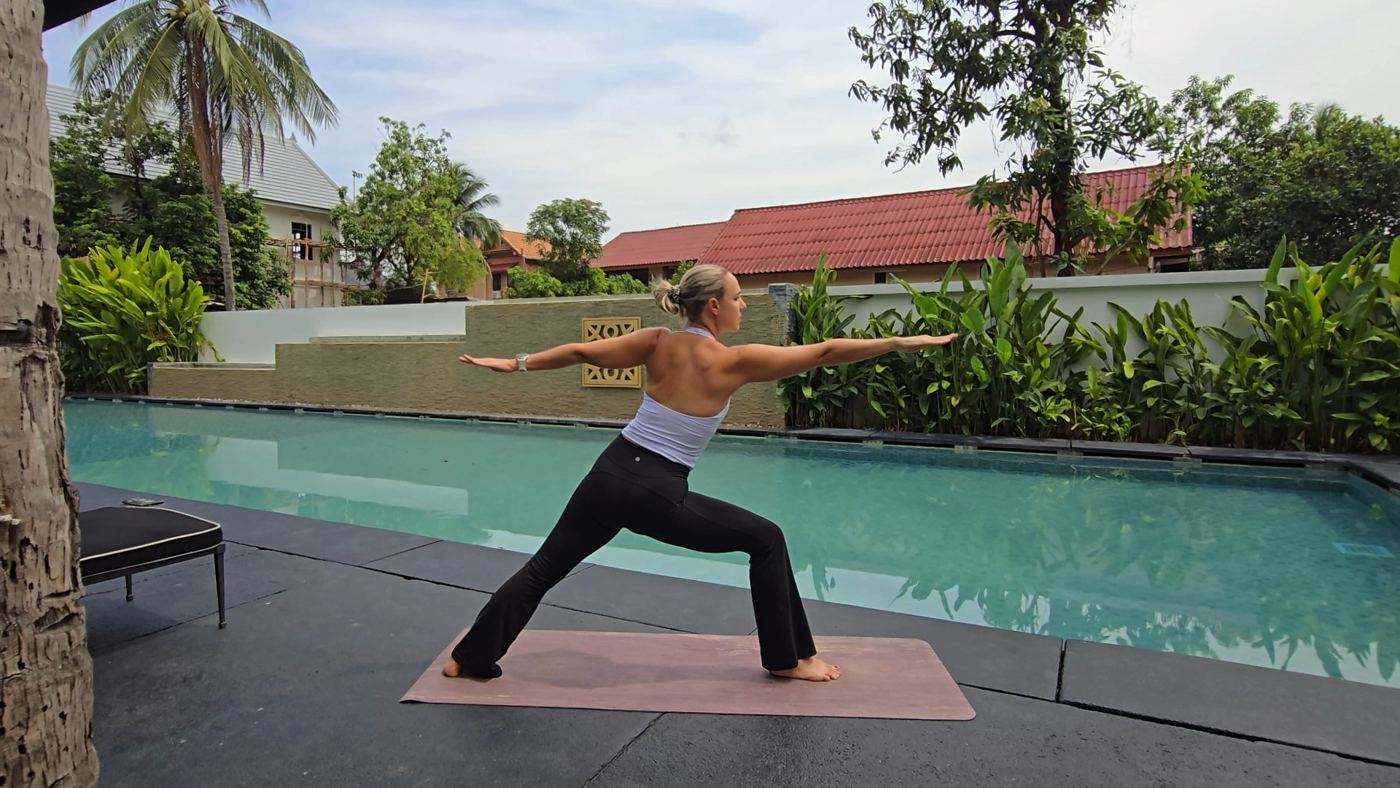
I hear this a lot, and I used to believe it about my own practice too: people think they quit yoga because they stopped liking it. Almost nobody quits for that reason. They quit because the version of yoga they signed up for needed a kind of time and energy they didn't reliably have. A 60 minute class sounds great on a Sunday afternoon and sounds impossible on a Tuesday at 7am with a packed inbox and a kid who needs a ride to school. I've been there more times than I can count.
The problem was never motivation. It was design. That's the whole reason I built my classes the way I did.
What the research says, and what I noticed in my own body
Behavioral scientists who study habit formation keep landing on the same finding: the size of the action matters less than the consistency of the action. A short routine done daily builds a stronger pathway than a long routine done sporadically. Your brain doesn't reward duration. It rewards repetition. I noticed this myself long before I read the research. The weeks I felt strongest were never the weeks I did one long class. They were the weeks I showed up daily for ten minutes.
This is why a 10 minute morning flow, done five days a week, will move your body and your mind further over three months than a single weekly 60 minute class you attend twice before life gets in the way.
What actually happens in a short session
A well built 10 to 15 minute flow isn't a watered down version of a long class. It's a different tool entirely. I built each one so you can move through a full range of motion, raise your heart rate, and settle your nervous system in that window. You don't need an hour to get your hips open or your shoulders unstuck. You need focused movement and cueing that doesn't waste your time talking.
The real metric isn't how long you practiced. It's how many days this month you showed up at all. Consistency compounds. A single long session does not.
How I use short sessions without losing depth
The trick is variety, not length. Instead of one long flow that hits everything, short sessions let you target different things on different days, a hip opening flow on Monday, a shoulder and upper back flow on Wednesday, a slow hamstring focused practice on Friday. Across a week you cover as much ground as one long class, just distributed in a way that fits an actual calendar. This is exactly how I structure the library.
- Pick a fixed time slot. Right after you wake up or right before bed removes the decision making that kills consistency.
- Treat 10 minutes as a complete session, not a warm up. If you finish and want more, do another. But don't skip the day because you only have 10 minutes.
- Rotate focus areas through the week rather than trying to do everything in one sitting.
Why I built it this way
If the only yoga that counts in your mind is the hour long studio class, you're setting yourself up to quit. I know, because that used to be me. Short, full body flows aren't a compromise. For most people with full schedules, they're simply the more effective format.
Every class I've put inside this app runs between 10 and 30 minutes for exactly this reason. My goal was never to build the longest class library. It was to build one you'd actually finish.